Why do you react the way you do? How your past shapes who you are today

Exploring old patterns, the subconscious, the influence of your family system and the possibility of creating new ways forward.
Have you ever felt as though you keep finding yourself in the same situations? That sometimes you react in a way you really don't want to? Or that your feelings seem much stronger than the situation itself would justify?
Perhaps you find it difficult to say no. You may feel responsible for others, worry about disappointing people or have a tendency to want to keep everything under control.
You might regularly tell yourself that next time you will do things differently, yet when the moment comes, you find yourself reacting in exactly the same way.
Why is that?
We often try to understand our current behaviour by looking at what is happening in our lives right now. But sometimes the roots of our reactions go much further back. They may lie in childhood experiences, the way we grew up and the role we took on within our family.
What if the way you behave today isn't random, but has a deeper origin?
We are shaped from the moment we are born
From the moment we are born, we become part of a system. Our family of origin is the first environment in which we learn how the world works, what relationships feel like and what place we occupy within them.
As children, we depend entirely on our parents or caregivers. We need safety, love, attention and connection. In order to maintain that connection, we adapt to our surroundings. Often, we do this without even realising it.
A child who notices that there is little room for sadness may learn to hide their feelings. A child growing up in an environment filled with tension may become very sensitive to other people's moods. And a child who is given a lot of responsibility at an early age may learn to look after others while putting their own needs aside.
Not because the child chooses to do so, but because, at that moment, it seems like the best way to cope with the circumstances.
In this way, we develop beliefs and patterns of behaviour that help us feel safe and connected. Perhaps we begin to believe that we always have to do our best to be appreciated, that we must never disappoint others, that we have to be strong, avoid making mistakes or make sure we don't take up too much space.
Over time, these beliefs can quietly become part of who we think we are.
But are they really yours? Or did you once learn that this was how things had to be?
What our bodies carry with them
Experiences are not only stored as conscious memories. They can also influence our nervous system, our stress responses and the way our bodies react to certain situations.
When we experience something overwhelming, frightening or unsafe, our body tries to protect us.
Our nervous system is constantly looking for signals of safety and danger. It may prepare us to fight, flee or freeze.
When we experience prolonged stress or trauma, certain protective responses can become deeply ingrained.
Think, for example, of someone who experienced a lot of unpredictability growing up. As an adult, they may find themselves constantly alert to other people's moods. Even a small change in someone's tone of voice can trigger tension.
Or someone who learned that emotions were not welcome and now finds it difficult to express their feelings or ask for help.
In a way, the body can learn responses that were once necessary, but that may no longer serve us in our lives today.
Experiences can leave lasting traces in the way our nervous system functions and how we process stress. This does not mean that trauma is literally stored in our cells as a memory. However, overwhelming experiences can certainly influence our physical and emotional responses.
Sometimes our body reacts before our mind has even understood what is happening.
The subconscious knows more than we think
We are not always aware of why we do or feel certain things.
Many of our responses happen automatically. Our brain recognises situations, makes connections with past experiences and helps us respond quickly.
This is useful, but it can also mean that old experiences continue to influence our lives today.
Imagine that, as a child, you were often criticised when you made a mistake. Perhaps you learned to do everything as well as possible, avoid mistakes and constantly prove yourself.
Years later, someone makes a comment about something you have done. They may not mean anything negative by it, but you immediately feel insecure, upset or the need to defend yourself.
What is actually being touched or triggered in that moment?
Perhaps you are not only responding to the situation in front of you, but also to a feeling you have known for a very long time.
A certain tone of voice, a look, someone's attitude or a particular event can unconsciously bring something from the past to the surface. We call this a trigger.
A trigger can cause your body and emotions to react as though you are back in an old situation. Your mind may know that you are safe, but inside, it feels different.
That is why it can be helpful to look beyond your immediate reaction and explore what might lie underneath it.
What am I actually feeling? What is this situation touching in me? Does this feeling seem familiar? Have I experienced something like this before?
By asking yourself these questions, you create space for greater awareness.
The influence of our family system
We are shaped not only by our own experiences, but also by the dynamics within our family and the wider family system.
Every family has its own roles, expectations and unwritten rules. Sometimes these are very obvious, but often they operate beneath the surface, without us being aware of them.
Perhaps there was little room for emotions in your family. Maybe you had to become independent at an early age, or you felt responsible for the wellbeing of one of your parents.
Sometimes children unknowingly take on a role that was never theirs to carry.
The child who is always strong.
The child who tries to prevent conflict.
The child who looks after everyone else.
The child who puts their own needs aside to keep the peace.
These roles can continue to influence us later in adult life.
Perhaps you notice that you are always the one who solves everything. That you find it difficult to set boundaries or feel guilty when you choose yourself.
Experiences from previous generations can also influence the dynamics within a family. Events such as loss, war, exclusion or prolonged uncertainty may affect how parents raise their children and how certain beliefs and ways of coping are passed on.
This does not mean that you automatically carry the trauma of a previous generation.
However, patterns, beliefs and ways of dealing with emotions can be passed down from one generation to the next.
In systemic work, we therefore look not only at the individual, but also at the wider family system in which they grew up.
What can family constellations bring to light?
Sometimes you know perfectly well, on an intellectual level, that you want to do things differently, yet you still find it difficult to break a familiar pattern.
You may understand where your behaviour comes from, but still have the feeling that something deeper is going on.
A family constellation can help you look at yourself and your family system from a different perspective.
During a constellation, people, positions or themes are represented spatially. This allows you to explore, quite literally, how you relate to certain people or situations.
For example, you might explore:
What place do I take within my family?
Do I feel responsible for other people?
Do I give enough space to my own needs?
Which patterns do I recognise from my family?
Do I find it difficult to take my own place?
Looking at a situation in a different way can lead to new insights.
Sometimes you suddenly recognise a pattern you have been carrying for years. At other times, you discover that a belief you have always taken for granted does not necessarily have to be true.
A constellation does not provide an absolute truth about your family history. Rather, it offers an experiential way to explore what you feel, what resonates with you and what you may want to approach differently.
And sometimes, that is where something begins to shift.
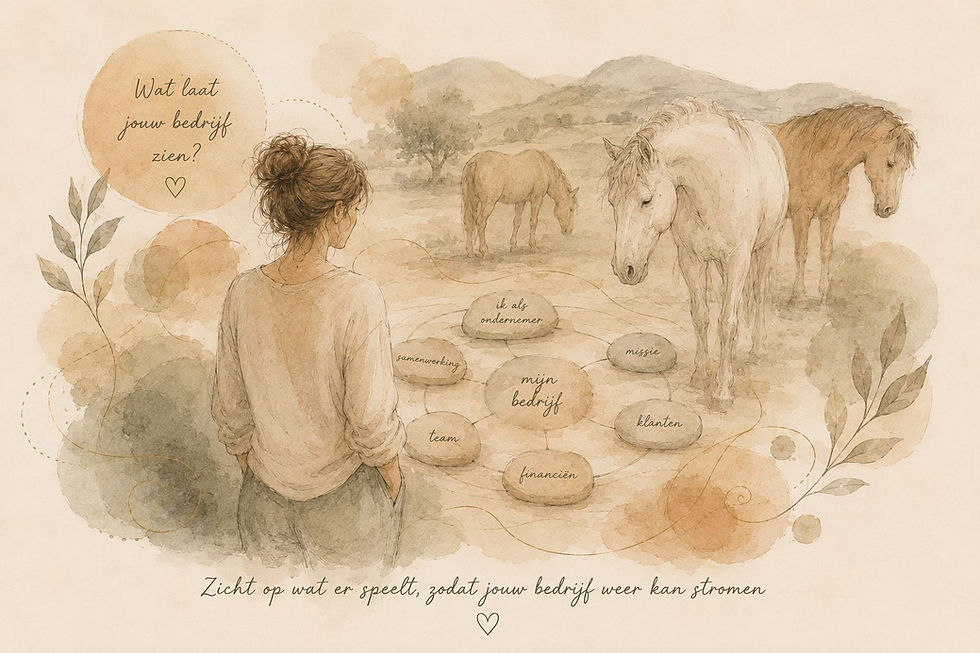
The horse as a mirror
At La Sonrisa – Coaching with Horses, I combine personal development with the unique experience of working with horses.
Horses live in the present moment. They communicate mainly through body language and are highly responsive to their surroundings. They notice changes in movement, posture, tension and behaviour.
During a horse-assisted coaching session, this can help you see yourself in a different way.
Perhaps you notice how much you try to stay in control. Maybe you find it difficult to express clearly what you want. Or perhaps you discover what it feels like to become calmer, take up space and experience trust.
The horse can invite you to pause and become aware of what is happening within you in that moment.
Not because the horse knows your past or can tell you what trauma you may have experienced. Rather, the interaction with the horse can help you become more aware of your own behaviour, feelings and body language.
In my coaching, I explore these experiences with you and help you reflect on what they might mean for you.
Sometimes an experience with a horse brings something to the surface that you might not have reached through talking alone.
It is not about getting things right or wrong. It is about exploring, experiencing and becoming more aware.
From old patterns to new possibilities
Many of the patterns that limit us today once developed as a way of protecting us.
Perhaps you learned to adapt to fit in. To be strong because there was little room for vulnerability. Or to always look after others because, at the time, you felt that was what you needed to do.
It is valuable to look at these patterns with kindness and compassion.
After all, you did not develop them without reason. At some point, they served a purpose.
But what you once needed to get through difficult circumstances does not have to determine how you live your life today.
You can learn to say no without feeling guilty. You can discover that you are not always responsible for other people's feelings. You are allowed to take up space, and your needs matter too.
You cannot change the past, but you can explore the influence it still has on you.
As you become more aware of your patterns, you create space to make different choices.
Not overnight, but step by step.
What if you learned to understand yourself differently?
Sometimes we look for solutions outside ourselves. We try to change our behaviour, work even harder or keep raising the bar for ourselves.
But perhaps the first step is not about working harder on yourself.
Perhaps it starts with simply pausing.
Becoming curious about your own feelings, reactions and beliefs. Exploring where certain patterns come from and the role they still play in your life today.
Through systemic work and horse-assisted coaching, I invite you to explore that space.
At La Sonrisa – Coaching with Horses, I would love to support you in gaining new insights, recognising familiar patterns and discovering new possibilities.
Because you are not only shaped by what you have experienced. You also have the opportunity to discover how you want to move forward.
Sometimes change begins with one simple question: Why do I actually do what I do? 💛
And perhaps that is the beginning of an entirely new way forward.